

VALID AZ-305 Exam Dumps For Certification Exam Preparation
AZ-305 Dumps PDF 2024 Strategy Your Preparation Efficiently
Microsoft AZ-305 exam is part of the Microsoft Certified: Azure Solutions Architect Expert certification path, along with the AZ-304 (Microsoft Azure Architect Design) exam. Designing Microsoft Azure Infrastructure Solutions certification path is tailored for professionals who want to demonstrate their ability to design and implement solutions that run on Microsoft Azure. Earning the Microsoft Certified: Azure Solutions Architect Expert certification validates your skills and knowledge of Azure architecture, infrastructure, and security, and can help you advance your career as an Azure solutions architect.
NEW QUESTION # 54
You plan to create an Azure environment that will contain a root management group and 10 child management groups. Each child management group will contain five Azure subscriptions. You plan to have between 10 and 30 resource groups in each subscription.
You need to design an Azure governance solution. The solution must meet the following requirements:
* Use Azure Blueprints to control governance across all the subscriptions and resource groups.
* Ensure that Blueprints-based configurations are consistent across all the subscriptions and resource groups.
* Minimize the number of blueprint definitions and assignments.
What should you include in the solution? To answer, select the appropriate options in the answer are a. NOTE: Each correct selection is worth one point.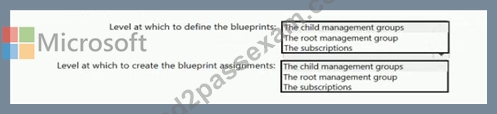
Answer:
Explanation: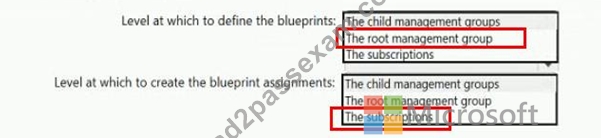
Reference:
Assign a blueprint After a blueprint has been published, it can be assigned to a subscription. Assign the blueprint that you created to one of the subscriptions under your management group hierarchy. If the blueprint is saved to a subscription, it can only be assigned to that subscription.
NEW QUESTION # 55
You plan to migrate App1 to Azure.
You need to recommend a high-availability solution for App1. The solution must meet the resiliency requirements.
What should you include in the recommendation? To answer, select the appropriate options in the answer area.
NOTE: Each correct selection is worth one point.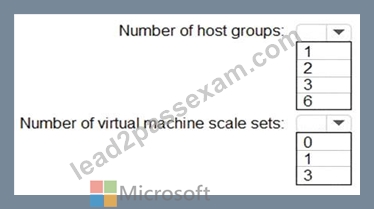
Answer:
Explanation: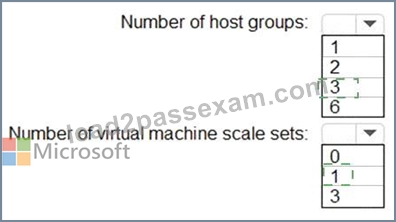
Explanation
Graphical user interface, text, application, email Description automatically generated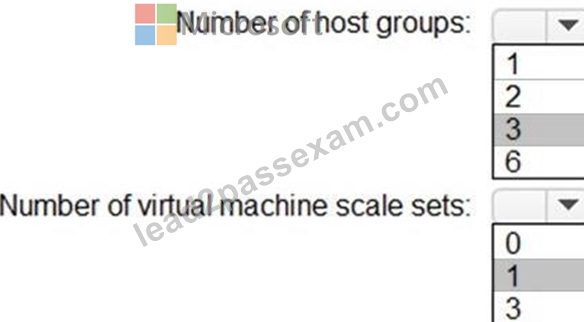
Box 1: 3
Scenario: App1 must meet the following requirements:
* Be hosted in an Azure region that supports availability zones.
* Maintain availability if two availability zones in the local Azure region fail.
A host group is a resource that represents a collection of dedicated hosts. You create a host group in a region and an availability zone, and add hosts to it.
Use Availability Zones for fault isolation
Availability zones are unique physical locations within an Azure region. Each zone is made up of one or more datacenters equipped with independent power, cooling, and networking. A host group is created in a single availability zone. Once created, all hosts will be placed within that zone. To achieve high availability across zones, you need to create multiple host groups (one per zone) and spread your hosts accordingly.
Box 2: 1
Scenario: App1 must meet the following requirements:
* Be hosted on Azure virtual machines that support automatic scaling.
An Azure virtual machine scale set can automatically increase or decrease the number of VM instances that run your application. This automated and elastic behavior reduces the management overhead to monitor and optimize the performance of your application.
Reference:
https://docs.microsoft.com/en-us/azure/virtual-machines/dedicated-hosts
https://docs.microsoft.com/en-us/azure/virtual-machine-scale-sets/virtual-machine-scale-sets-autoscale-overview
Topic 1, Litware, Inc
Case Study
This is a case study. Case studies are not timed separately. You can use as much exam time as you would like to complete each case. However, there may be additional case studies and sections on this exam. You must manage your time to ensure that you are able to complete all questions included on this exam in the time provided.
To answer the questions included in a case study, you will need to reference information that is provided in the case study. Case studies might contain exhibits and other resources that provide more information about the scenario that is described in the case study. Each question is independent of the other questions in this case study.
At the end of this case study, a review screen will appear. This screen allows you to review your answers and to make changes before you move to the next section of the exam. After you begin a new section, you cannot return to this section.
To start the case study
To display the first question in this case study, click the button. Use the buttons in the left pane to explore the content of the case study before you answer the questions. Clicking these buttons displays information such as business requirements, existing environment, and problem statements. If the case study has an All Information tab, note that the information displayed is identical to the information displayed on the subsequent tabs. When you are ready to answer a question, click the button to return to the question.
Overview. General Overview
Litware, Inc. is a medium-sized finance company.
Overview. Physical Locations
Litware has a main office in Boston.
Existing Environment. Identity Environment
The network contains an Active Directory forest named Litware.com that is linked to an Azure Active Directory (Azure AD) tenant named Litware.com. All users have Azure Active Directory Premium P2 licenses.
Litware has a second Azure AD tenant named dev.Litware.com that is used as a development environment.
The Litware.com tenant has a conditional acess policy named capolicy1. Capolicy1 requires that when users manage the Azure subscription for a production environment by using the Azure portal, they must connect from a hybrid Azure AD-joined device.
Existing Environment. Azure Environment
Litware has 10 Azure subscriptions that are linked to the Litware.com tenant and five Azure subscriptions that are linked to the dev.Litware.com tenant. All the subscriptions are in an Enterprise Agreement (EA).
The Litware.com tenant contains a custom Azure role-based access control (Azure RBAC) role named Role1 that grants the DataActions read permission to the blobs and files in Azure Storage.
Existing Environment. On-premises Environment
The on-premises network of Litware contains the resources shown in the following table.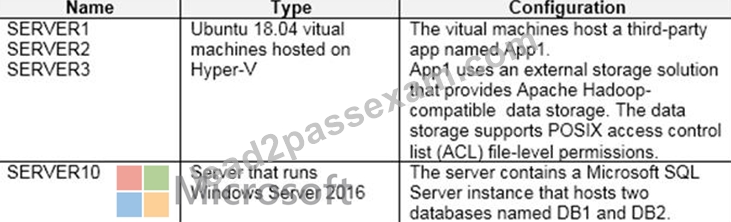
Existing Environment. Network Environment
Litware has ExpressRoute connectivity to Azure.
Planned Changes and Requirements. Planned Changes
Litware plans to implement the following changes:
* Migrate DB1 and DB2 to Azure.
* Migrate App1 to Azure virtual machines.
* Deploy the Azure virtual machines that will host App1 to Azure dedicated hosts.
Planned Changes and Requirements. Authentication and Authorization Requirements Litware identifies the following authentication and authorization requirements:
* Users that manage the production environment by using the Azure portal must connect from a hybrid Azure AD-joined device and authenticate by using Azure Multi-Factor Authentication (MFA).
* The Network Contributor built-in RBAC role must be used to grant permission to all the virtual networks in all the Azure subscriptions.
* To access the resources in Azure, App1 must use the managed identity of the virtual machines that will host the app.
* Role1 must be used to assign permissions to the storage accounts of all the Azure subscriptions.
* RBAC roles must be applied at the highest level possible.
Planned Changes and Requirements. Resiliency Requirements
Litware identifies the following resiliency requirements:
* Once migrated to Azure, DB1 and DB2 must meet the following requirements:
- Maintain availability if two availability zones in the local Azure region fail.
- Fail over automatically.
- Minimize I/O latency.
* App1 must meet the following requirements:
- Be hosted in an Azure region that supports availability zones.
- Be hosted on Azure virtual machines that support automatic scaling.
- Maintain availability if two availability zones in the local Azure region fail.
Planned Changes and Requirements. Security and Compliance Requirements
Litware identifies the following security and compliance requirements:
* Once App1 is migrated to Azure, you must ensure that new data can be written to the app, and the modification of new and existing data is prevented for a period of three years.
* On-premises users and services must be able to access the Azure Storage account that will host the data in App1.
* Access to the public endpoint of the Azure Storage account that will host the App1 data must be prevented.
* All Azure SQL databases in the production environment must have Transparent Data Encryption (TDE) enabled.
* App1 must not share physical hardware with other workloads.
Planned Changes and Requirements. Business Requirements
Litware identifies the following business requirements:
* Minimize administrative effort.
* Minimize costs.
NEW QUESTION # 56
You plan to create an Azure Storage account that will host file shares. The shares will be accessed from on-premises applications that are transaction-intensive.
You need to recommend a solution to minimize latency when accessing the file shares. The solution must provide the highest-level of resiliency for the selected storage tier.
What should you include in the recommendation? To answer, select the appropriate options in the answer area.
NOTE: Each correct selection is worth one point.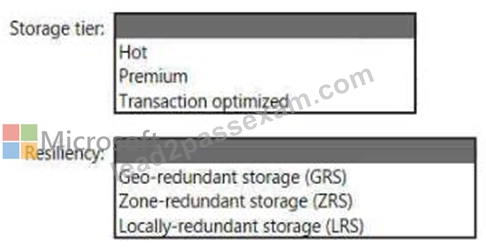
Answer:
Explanation: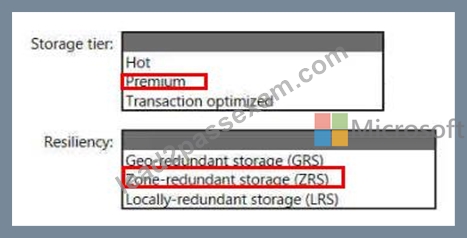
Reference:
https://docs.microsoft.com/en-us/azure/storage/files/storage-files-planning
NEW QUESTION # 57
You need to recommend a solution that meets the data requirements for App1.
What should you recommend deploying to each availability zone that contains an instance of App1?
- A. an Azure Storage account that uses geo-zone-redundant storage (GZRS)
- B. an Azure SQL database that uses active geo-replication
- C. an Azure Cosmos DB that uses multi-region writes
- D. an Azure Data Lake store that uses geo-zone-redundant storage (GZRS)
Answer: C
NEW QUESTION # 58
Your company has two on-premises sites in New York and Los Angeles and Azure virtual networks in the East US Azure region and the West US Azure region. Each on-premises site has Azure ExpressRoute circuits to both regions.
You need to recommend a solution that meets the following requirements:
Outbound traffic to the Internet from workloads hosted on the virtual networks must be routed through the closest available on-premises site.
If an on-premises site fails, traffic from the workloads on the virtual networks to the Internet must reroute automatically to the other site.
What should you include in the recommendation? To answer, select the appropriate options in the answer area.
NOTE: Each correct selection is worth one point.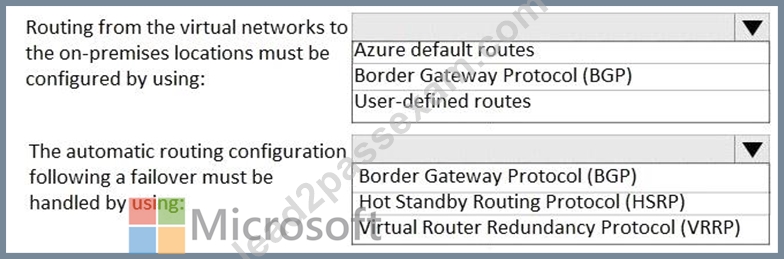
Answer:
Explanation: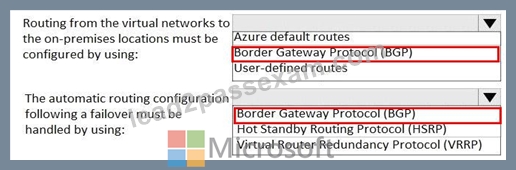
NEW QUESTION # 59
You plan to migrate DB1 and DB2 to Azure.
You need to ensure that the Azure database and the service tier meet the resiliency and business requirements.
What should you configure? To answer, select the appropriate options in the answer area.
NOTE: Each correct selection is worth one point.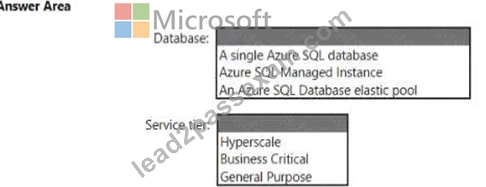
Answer:
Explanation: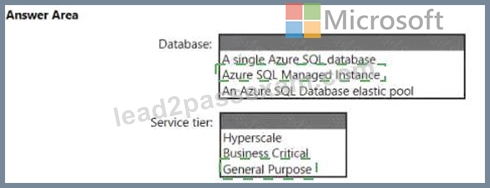
Explanation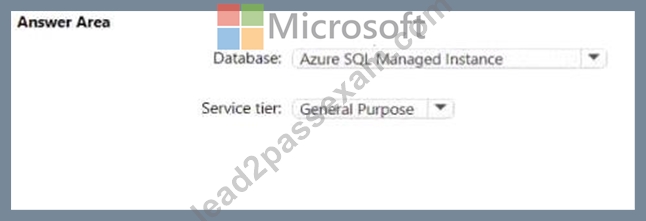
NEW QUESTION # 60
You have two app registrations named App1 and App2 in Azure AD. App1 supports role-based access control (RBAC) and includes a role named Writer.
You need to ensure that when App2 authenticates to access App1, the tokens issued by Azure AD include the Writer role claim.
Which blade should you use to modify each app registration? To answer, drag the appropriate blades to the correct app registrations. Each blade may be used once, more than once, or not at all. You may need to drag the split bar between panes or scroll to view content.
NOTE: Each correct selection is worth one point.
Answer:
Explanation:
Explanation
NEW QUESTION # 61
You plan to import data from your on-premises environment to Azure. The data Is shown in the following table.
What should you recommend using to migrate the data? To answer, drag the appropriate tools to the correct data sources-Each tool may be used once, more than once, or not at all. You may need to drag the split bar between panes or scroll to view content.
NOTE: Each correct selection is worth one point.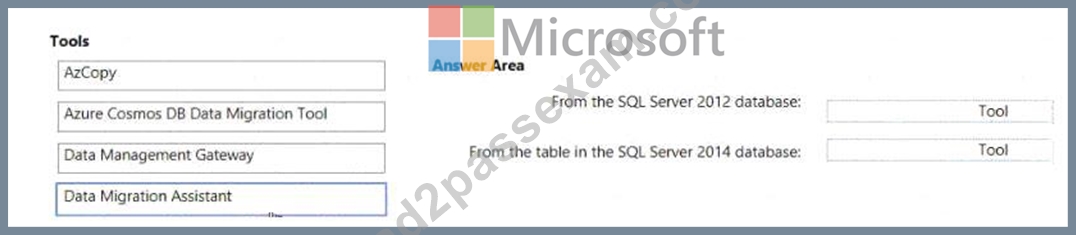
Answer:
Explanation: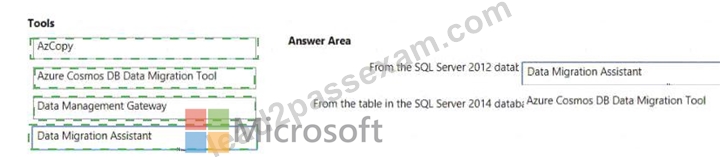
Explanation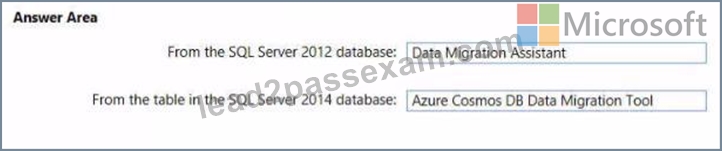
References:
https://docs.microsoft.com/en-us/azure/dms/tutorial-sql-server-to-azure-sql
https://docs.microsoft.com/en-us/azure/cosmos-db/import-data
NEW QUESTION # 62
You need to recommend a solution that meets the application development requirements.
What should you include in the recommendation?
- A. Continuous Integration/Continuous Deployment (CI/CD) sources
- B. an Azure Container Registry instance
- C. the Azure App Configuration service
- D. deployment slots
Answer: D
Explanation:
Topic 4, HABInsurance
Case Study
An insurance company, HABInsurance, operates in three states and provides home, auto, and boat insurance.
Besides the head office, HABInsurance has three regional offices.
Current environment
General
An insurance company, HABInsurance, operates in three states and provides home, auto, and boat insurance.
Besides the head office, HABInsurance has three regional offices.
Technology assessment
The company has two Active Directory forests: main.habinsurance.com and region.habinsurance.com.
HABInsurance's primary internal system is Insurance Processing System (IPS). It is an ASP.Net/C# application running on IIS/Windows Servers hosted in a data center. IPS has three tiers: web, business logic API, and a datastore on a back end. The company uses Microsoft SQL Server and MongoDB for the backend.
The system has two parts: Customer data and Insurance forms and documents. Customer data is stored in Microsoft SQL Server and Insurance forms and documents-in MongoDB. The company also has 10 TB of Human Resources (HR) data stored on NAS at the head office location. Requirements General HABInsurance plans to migrate its workloads to Azure. They purchased an Azure subscription. Changes During a transition period, HABInsurance wants to create a hybrid identity model along with a Microsoft Office 365 deployment. The company intends to sync its AD forests to Azure AD and benefit from Azure AD administrative units functionality.
HABInsurance needs to migrate the current IPSCustomers SQL database to a new fully managed SQL database in Azure that would be budget-oriented, balanced with scalable compute and storage options. The management team expects the Azure database service to scale the database resources dynamically with minimal downtime. The technical team proposes implementing a DTU-based purchasing model for the new database.
HABInsurance wants to migrate Insurance forms and documents to Azure database service. HABInsurance plans to move IPS first two tiers to Azure without any modifications. The technology team discusses the possibility of running IPS tiers on a set of virtual machines instances. The number of instances should be adjusted automatically based on the CPU utilization. An SLA of99.95% must be guaranteed for the compute infrastructure.
The company needs to move HR data to Azure File shares.
In their new Azure ecosystem, HABInsurance plans to use internal and third-party applications. The company considers adding user consent for data access to the registered applications Later, the technology team contemplates adding a customer self-service portal to IPS and deploying a new IPS to multi-region ASK. But the management team is worried about performance and availability of the multi-region AKS deployments during regional outages.
NEW QUESTION # 63
You need to implement the Azure RBAC role assignment. The solution must meet the authentication and authorization requirements.
How many assignment should you configure for the Network Contributor role for Role1? To answer, select appropriate in the answer area.
NOTE: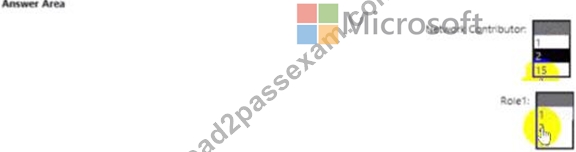
Answer:
Explanation:
Explanation
A screenshot of a computer Description automatically generated with medium confidence
NEW QUESTION # 64
You have an on-premises file server that stores 2 TB of data files.
You plan to move the data files to Azure Blob Storage In the West Europe Azure region, You need to recommend a storage account type to store the data files and a replication solution for the storage account. The solution must meet the following requirements:
* Be available if a single Azure datacenter fails.
* Support storage tiers.
* Minimize cost.
What should you recommend? To answer, select the appropriate options in the answer area.
NOTE: Each correct selection is worth one point.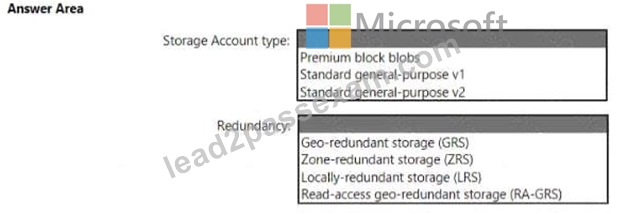
Answer:
Explanation: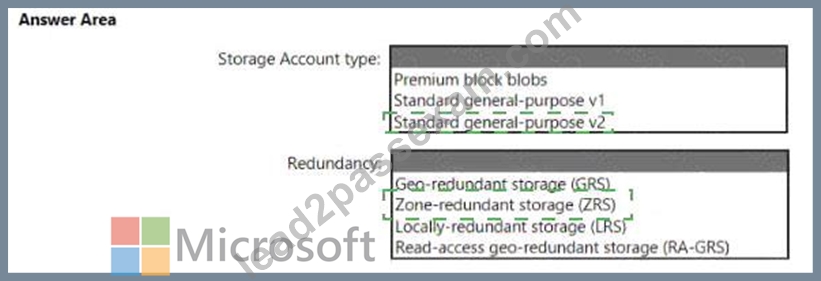
Explanation
Account Type: StorageV2
Replication solution: Zone-redundant storage (ZRS)
https://docs.microsoft.com/en-us/azure/storage/common/storage-redundancy
https://docs.microsoft.com/en-us/azure/storage/common/storage-redundancy#supported-azure-storage-services
https://docs.microsoft.com/en-us/azure/storage/common/storage-account-overview#types-of-storage-accounts Data must be available if a single Azure datacenter fails. It means the storage account must support ZRS replication. Also, solution should support storage tiers. Only General-purpose V2 supports ZRS and storage tiers.
https://docs.microsoft.com/en-us/azure/storage/blobs/storage-blob-storage-tiers
NEW QUESTION # 65
You plan to deploy Azure Databricks to support a machine learning application. Data engineers will mount an Azure Data Lake Storage account to the Databricks file system. Permissions to folders are granted directly to the data engineers.
You need to recommend a design for the planned Databrick deployment. The solution must meet the following requirements:
* Ensure that the data engineers can only access folders to which they have permissions.
* Minimize development effort.
* Minimize costs.
What should you include in the recommendation? To answer, select the appropriate options in the answer area.
NOTE: Each correct selection is worth one point.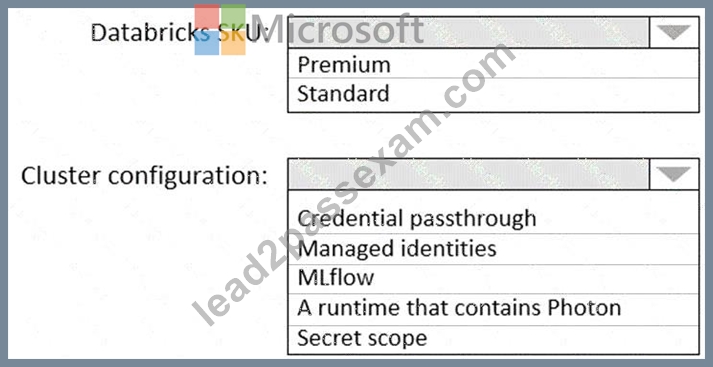
Answer:
Explanation: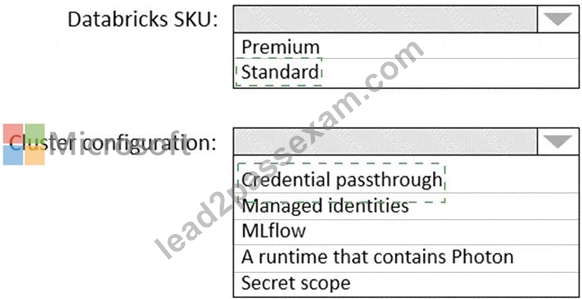
Explanation
Box 1: Standard
Choose Standard to minimize costs.
Box 2: Credential passthrough
Athenticate automatically to Azure Data Lake Storage Gen1 (ADLS Gen1) and Azure Data Lake Storage Gen2 (ADLS Gen2) from Azure Databricks clusters using the same Azure Active Directory (Azure AD) identity that you use to log into Azure Databricks. When you enable Azure Data Lake Storage credential passthrough for your cluster, commands that you run on that cluster can read and write data in Azure Data Lake Storage without requiring you to configure service principal credentials for access to storage.
Reference:
https://docs.microsoft.com/en-us/azure/databricks/security/credential-passthrough/adls-passthrough
NEW QUESTION # 66
You have an Azure subscription that is linked to an Azure Active Directory Premium Plan 2 tenant The tenant has multi-factor authentication (MFA) enabled for all users.
You have the named locations shown in the following table.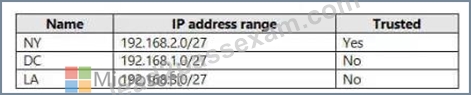
You have the users shown in the following table.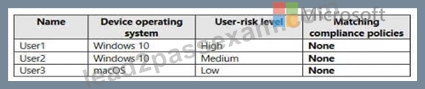
You plan to deploy the Conditional Access policies shown in the following table.
For each of the following statements, select Yes if the statement is true. Otherwise, select No.
NOTE: Each correct selection is worth one point.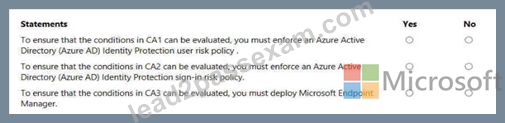
Answer:
Explanation: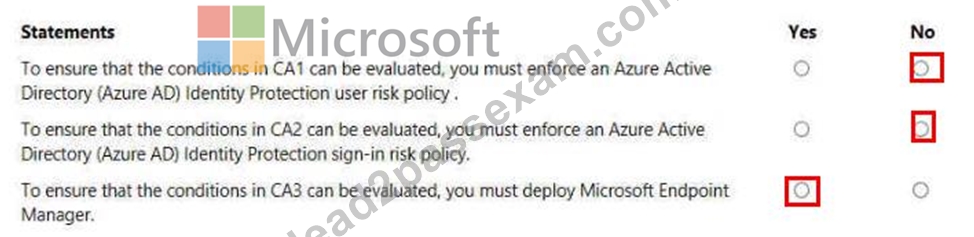
NEW QUESTION # 67
You have .NeT web service named service1 that has the following requirements.
Must read and write to the local file system.
Must write to the Windows Application event log.
You need to recommend a solution to host Service1 in Azure . The solution must meet the following requirements:
Minimize maintenance overhead.
Minimize costs.
What should you include in the recommendation?
- A. an Azure App Service web app
- B. an Azure virtual machine scale set
- C. an Azure Functions app
- D. an App Service Environment (ASE)
Answer: A
Explanation:
https://social.msdn.microsoft.com/Forums/vstudio/en-US/294b9e3e-e89c-4095-b8d0-ee1646e77268/writing-to-local-file-system-from-web-app-in-azure?forum=windowsazurewebsitespreview
NEW QUESTION # 68
Your company develops Azure applications.
You need to recommend a solution for the deployment of Azure subscriptions. The solution must meet the following requirements:
- A. Support deployments across all Azure regions.
- B. Create custom role-based access control (RBAC) roles.
- C. Provide consistent virtual machine and virtual network configurations.
- D. Provision resource groups.
Answer: C
Explanation:
What should you include in the recommendation?
Reference:
https://docs.microsoft.com/en-us/azure/governance/blueprints/overview
https://docs.microsoft.com/en-us/azure/azure-resource-manager/management/microsoft-resources-move-regions
https://docs.microsoft.com/en-us/azure/role-based-access-control/role-assignments-template
https://docs.microsoft.com/en-us/azure/virtual-machines/windows/template-description
NEW QUESTION # 69
You have the Azure resources shown in the following table.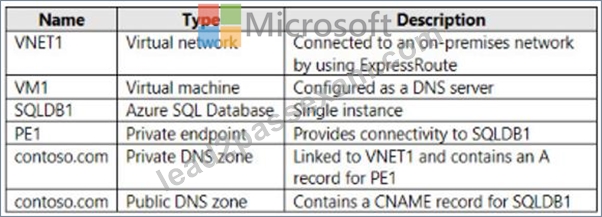
You need to design a solution that provides on-premises network connectivity to SQLDB1 through PE1. How should you configure name resolution? To answer, select the appropriate options in the answer area.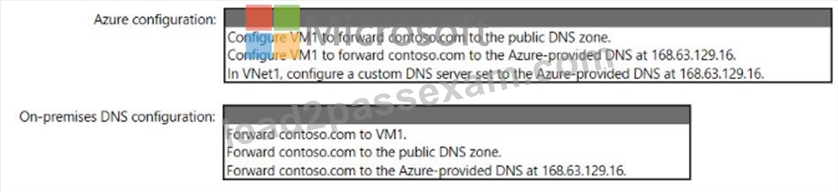
Answer:
Explanation: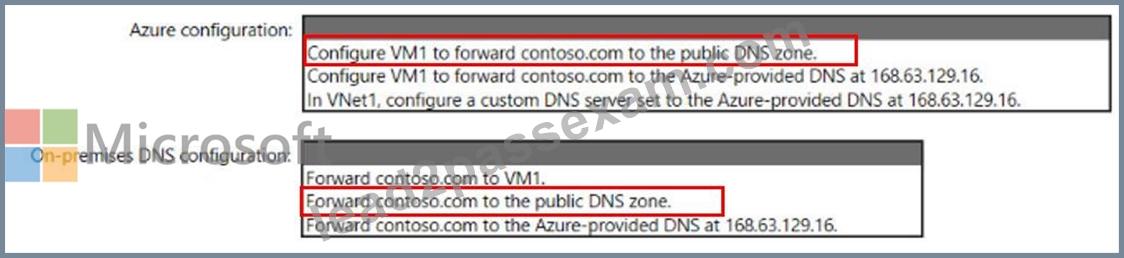
NEW QUESTION # 70
You have an Azure Active Directory (Azure AD) tenant.
You plan to use Azure Monitor to monitor user sign-ins and generate alerts based on specific user sign-in events.
You need to recommend a solution to trigger the alerts based on the events.
What should you include in the recommendation? To answer, select the appropriate options in the answer area.
NOTE: Each correct selection is worth one point.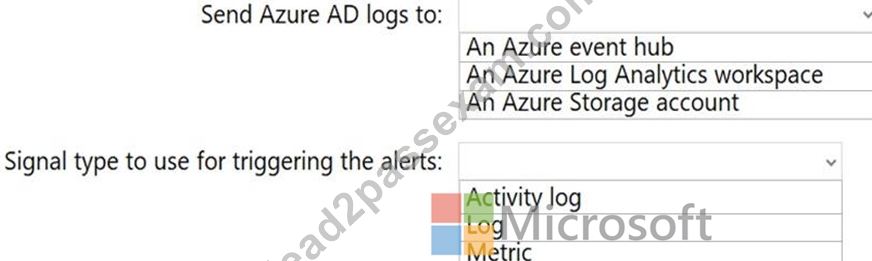
Answer:
Explanation: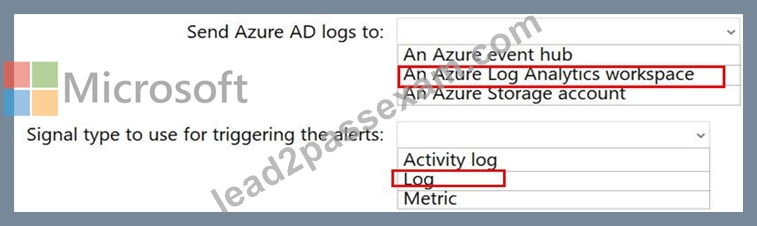
Reference:
https://4sysops.com/archives/how-to-create-an-azure-ad-admin-login-alert/
https://docs.microsoft.com/en-us/azure/azure-monitor/platform/alerts-log
NEW QUESTION # 71
How should the migrated databases DB1 and DB2 be implemented in Azure?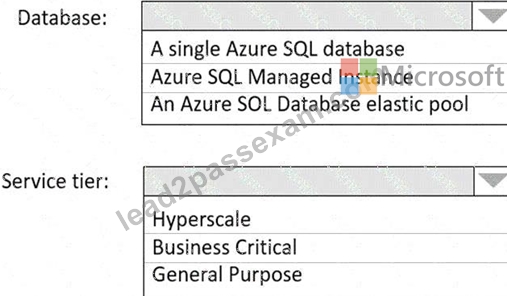
Answer:
Explanation: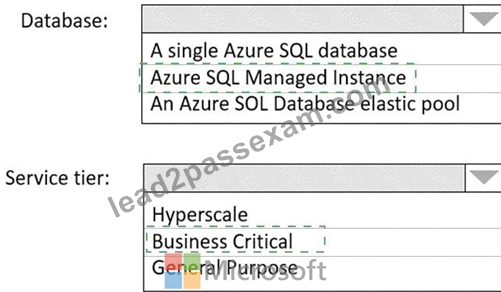
Explanation
Table Description automatically generated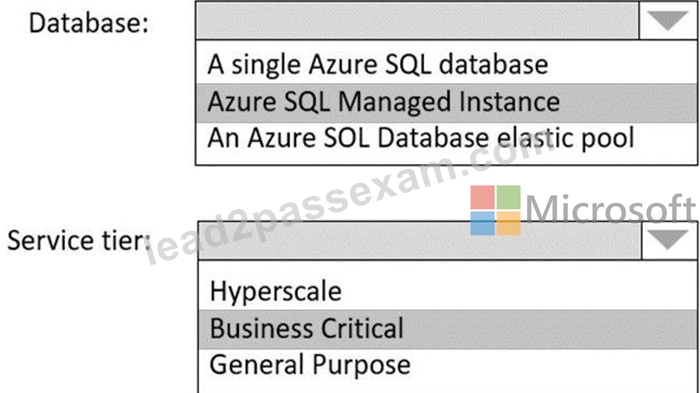
Box 1: SQL Managed Instance
Scenario: Once migrated to Azure, DB1 and DB2 must meet the following requirements:
* Maintain availability if two availability zones in the local Azure region fail.
* Fail over automatically.
* Minimize I/O latency.
The auto-failover groups feature allows you to manage the replication and failover of a group of databases on a server or all databases in a managed instance to another region. It is a declarative abstraction on top of the existing active geo-replication feature, designed to simplify deployment and management of geo-replicated databases at scale. You can initiate a geo-failover manually or you can delegate it to the Azure service based on a user-defined policy. The latter option allows you to automatically recover multiple related databases in a secondary region after a catastrophic failure or other unplanned event that results in full or partial loss of the SQL Database or SQL Managed Instance availability in the primary region.
Box 2: Business critical
SQL Managed Instance is available in two service tiers:
General purpose: Designed for applications with typical performance and I/O latency requirements.
Business critical: Designed for applications with low I/O latency requirements and minimal impact of underlying maintenance operations on the workload.
Reference:
https://docs.microsoft.com/en-us/azure/azure-sql/database/auto-failover-group-overview
https://docs.microsoft.com/en-us/azure/azure-sql/managed-instance/sql-managed-instance-paas-overview
NEW QUESTION # 72
You have 100 Microsoft SQL Server integration Services (SSIS) packages that are configured to use 10 on-premises SQL Server databases as their destinations.
You plan to migrate the 10 on-premises databases to Azure SQL Database
You need to recommend a solution to host the SSlS packages in Azure. The solution must ensure that the packages can target the SQL Database instances as their destinations.
What should you include in the recommendation?
- A. Azure Data Factory
- B. Data Migration Assistant
- C. Azure Data Catalog
- D. SQL Server Migration Assistant (SSMA)
Answer: A
Explanation:
Explanation
https://docs.microsoft.com/bs-cyrl-ba/azure/sql-database/sql-database-managed-instance-migrate Quote from that page "Azure SQL Database and SQL Server databases in an Azure Virtual Machine. DMS is the recommended method of migration for your enterprise workloads.
If you use SQL Server Integration Services (SSIS) on your SQL Server on premises, DMS does not yet support migrating SSIS catalog (SSISDB) that stores SSIS packages, but you can provision Azure-SSIS Integration Runtime (IR) in Azure Data Factory (ADF) that will create a new SSISDB in a managed instance and then you can redeploy your packages to it, see Create Azure-SSIS IR in ADF.
To learn more about this scenario and configuration steps for DMS, see Migrate your on-premises database to managed instance using DMS."
https://docs.microsoft.com/en-us/azure/data-factory/how-to-migrate-ssis-job-ssms
NEW QUESTION # 73
You need to ensure that users managing the production environment are registered for Azure MFA and must authenticate by using Azure MFA when they sign in to the Azure portal. The solution must meet the authentication and authorization requirements.
What should you do? To answer, select the appropriate options in the answer area.
NOTE: Each correct selection is worth one point.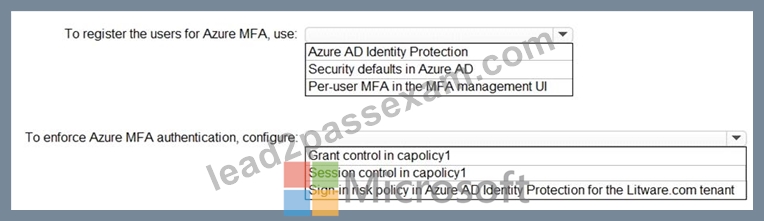
Answer:
Explanation: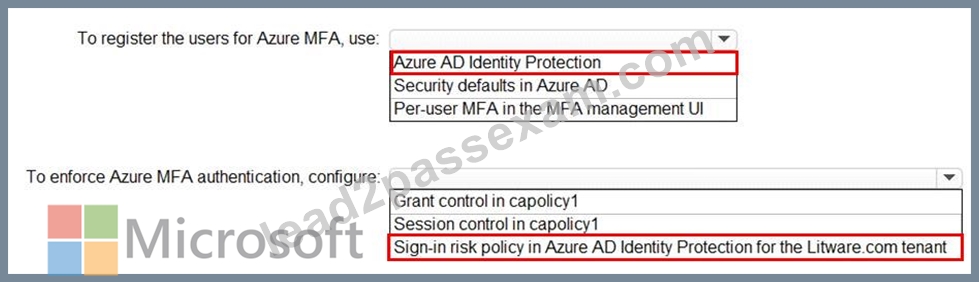
Reference:
https://docs.microsoft.com/en-us/azure/active-directory/identity-protection/howto-identity-protection-configure-mfa-policy
https://docs.microsoft.com/en-us/azure/active-directory/identity-protection/howto-identity-protection-configure-risk-policies
NEW QUESTION # 74
You are designing a virtual machine that will run Microsoft SQL Server and will contain two data disks. The first data disk will store log files, and the second data disk will store dat a. Both disks are P40 managed disks.
You need to recommend a caching policy for each disk. The policy must provide the best overall performance for the virtual machine.
Which caching policy should you recommend for each disk? To answer, drag the appropriate policies to the correct disks. Each policy may be used once, more than once, or not at all. You may need to drag the split bar between panes or scroll to view content.
NOTE: Each correct selection is worth one point.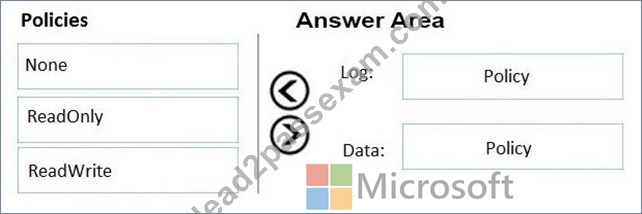
Answer:
Explanation: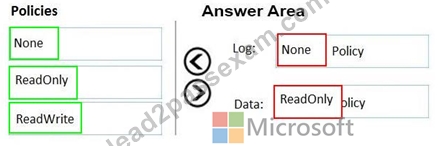
Reference:
https://docs.microsoft.com/en-us/azure/virtual-machines/windows/sql/virtual-machines-windows-sql-performance
NEW QUESTION # 75
You need to recommend a solution to ensure that App1 can access the third-party credentials and access strings. The solution must meet the security requirements.
What should you include in the recommendation? To answer, select the appropriate options in the answer area.
NOTE: Each correct selection is worth one point.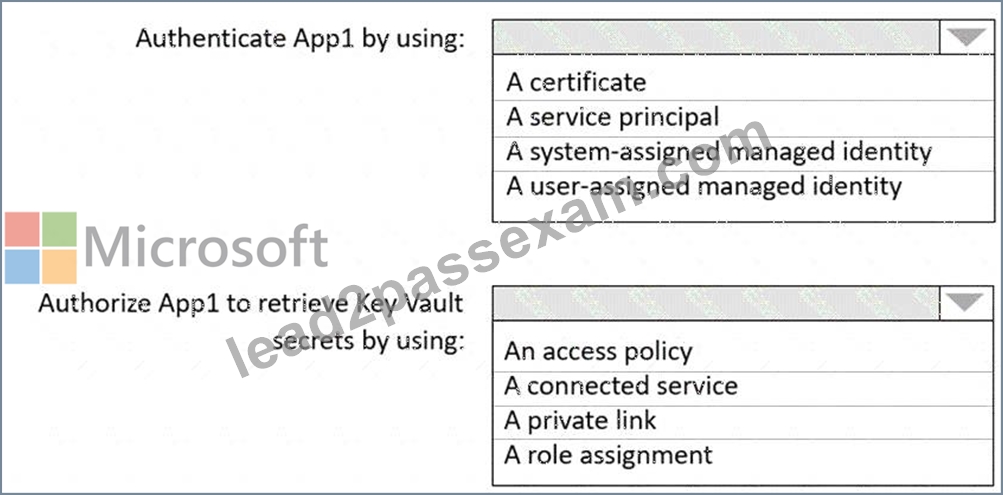
Answer:
Explanation: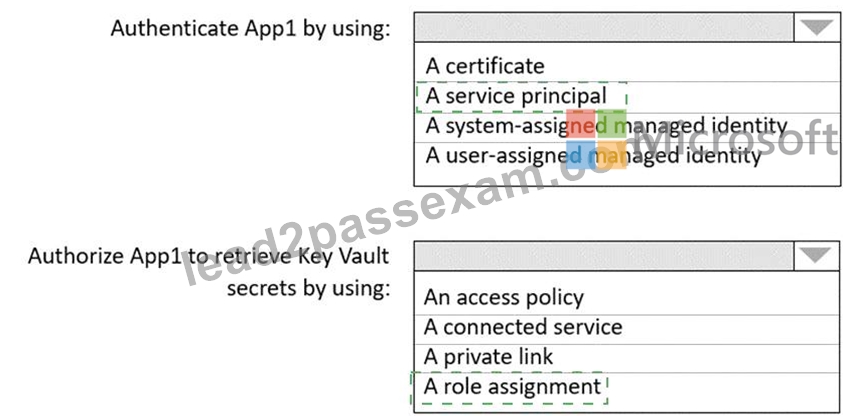
Explanation
Graphical user interface, text, application, table Description automatically generated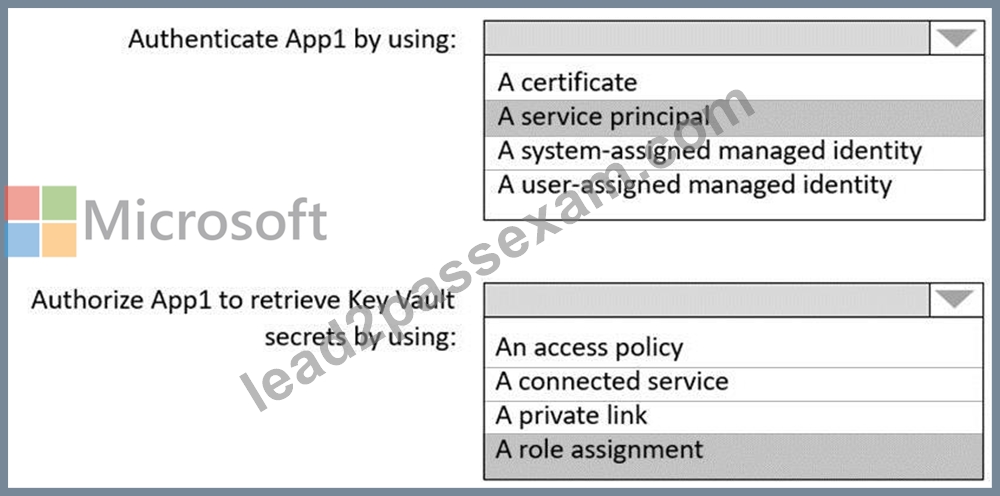
Scenario: Security Requirement
All secrets used by Azure services must be stored in Azure Key Vault.
Services that require credentials must have the credentials tied to the service instance. The credentials must NOT be shared between services.
Box 1: A service principal
A service principal is a type of security principal that identifies an application or service, which is to say, a piece of code rather than a user or group. A service principal's object ID is known as its client ID and acts like its username. The service principal's client secret acts like its password.
Note: Authentication with Key Vault works in conjunction with Azure Active Directory (Azure AD), which is responsible for authenticating the identity of any given security principal.
A security principal is an object that represents a user, group, service, or application that's requesting access to Azure resources. Azure assigns a unique object ID to every security principal.
Box 2: A role assignment
You can provide access to Key Vault keys, certificates, and secrets with an Azure role-based access control.
Reference:
https://docs.microsoft.com/en-us/azure/key-vault/general/authentication
NEW QUESTION # 76
You have an Azure subscription that contains the storage accounts shown in the following table.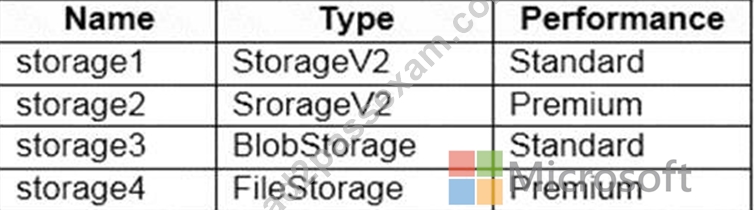
You plan to implement two new apps that have the requirements shown in the following table.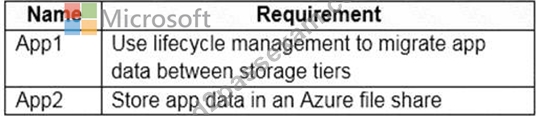
Which storage accounts should you recommend using for each app? To answer, select the appropriate options in the answer area.
NOTE:Each correct selection is worth one point.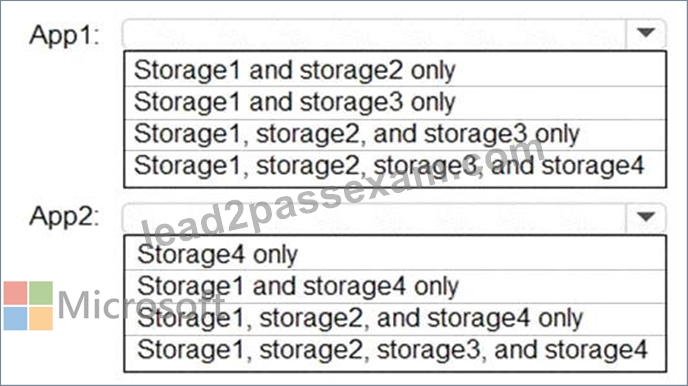
Answer:
Explanation: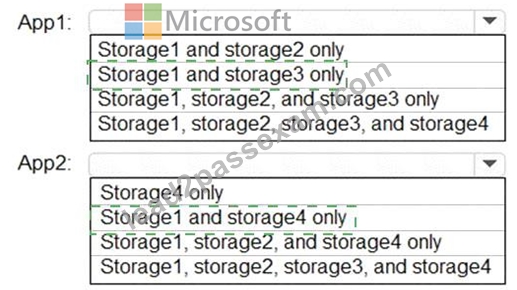
Explanation
https://docs.microsoft.com/en-us/azure/storage/common/storage-account-overview
https://www.edureka.co/community/40011/different-storage-accounts-there-major-difference-between
https://insidemstech.com/tag/general-purpose-v2/
In conclusion the correct answers are:
Box1 --> Storage1 and Storage3 only
Box2 --> Storage1 and Storage4 only
https://docs.microsoft.com/en-us/azure/storage/files/storage-how-to-create-file-share?tabs=azure-portal#basics
NEW QUESTION # 77
You need to design an Azure policy that will implement the following functionality:
* For new resources, assign tags and values that match the tags and values of the resource group to which the resources are deployed.
* For existing resources, identify whether the tags and values match the tags and values of the resource group that contains the resources.
* For any non-compliant resources, trigger auto-generated remediation tasks to create missing tags and values.
The solution must use the principle of least privilege.
What should you include in the design? To answer, select the appropriate options in the answer area.
NOTE: Each correct selection is worth one point.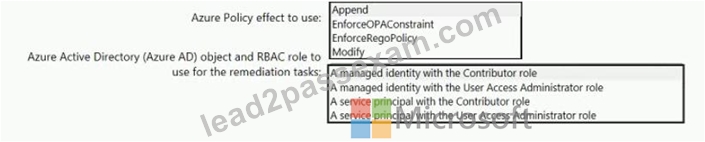
Answer:
Explanation: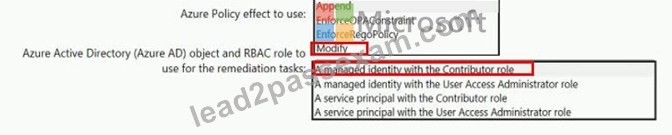
Reference:
https://docs.microsoft.com/en-us/azure/governance/policy/concepts/effects
https://docs.microsoft.com/en-us/azure/governance/policy/how-to/remediate-resources
https://docs.microsoft.com/en-us/azure/azure-resource-manager/management/tag-resources
https://docs.microsoft.com/en-us/azure/governance/policy/concepts/effects#modify
NEW QUESTION # 78
......
Latest Verified & Correct AZ-305 Questions: https://examsforall.lead2passexam.com/Microsoft/valid-AZ-305-exam-dumps.html