

The Best SPLK-1003 Exam Study Material Premium Files and Preparation Tool (Nov-2025)
Get Instant Access to SPLK-1003 Practice Exam Questions
NEW QUESTION # 14
What is the default character encoding used by Splunk during the input phase?
- A. EBCDIC
- B. UTF-16
- C. ISO 8859
- D. UTF-8
Answer: D
Explanation:
Explanation/Reference: https://docs.splunk.com/Documentation/Splunk/7.3.1/Data/Configurecharactersetencoding
NEW QUESTION # 15
When using a directory monitor input, specific source types can be selectively overridden using which configuration file?
- A. trans forms . conf
- B. sourcetypes . conf
- C. outputs . conf
- D. props . conf
Answer: D
Explanation:
When using a directory monitor input, specific source types can be selectively overridden using the props.
conf file. According to the Splunk documentation1, "You can specify a source type for data based on its input and source. Specify source type for an input. You can assign the source type for data coming from a specific input, such as /var/log/. If you use Splunk Cloud Platform, use Splunk Web to define source types. If you use Splunk Enterprise, define source types in Splunk Web or by editing the inputs.conf configuration file." However, this method is not very granular and assigns the same source type to all data from an input. To override the source type on a per-event basis, you need to use the props.conf file and the transforms.conf file2. The props.conf file contains settings that determine how the Splunk platform processes incoming data, such as how to segment events, extract fields, and assign source types2. The transforms.conf file contains settings that modify or filter event data during indexing or search time2. You can use these files to create rules that match specific patterns in the event data and assign different source types accordingly2. For example, you can create a rule that assigns a source type of apache_error to any event that contains the word "error" in the first line2.
NEW QUESTION # 16
Which of the following lists the three phases of the Splunk Indexing process in order?
- A. Ingest phaseLicensing phaseParsing phase
- B. Sourcetype phaseIndex phaseWrite-to-disk phase
- C. Ingest phaseTransforming phaseIndexing phase
- D. Input phaseParsing phaseIndexing phase
Answer: D
Explanation:
The Splunk indexing process consists of three main phases: Input, Parsing, and Indexing. Understanding these phases is crucial for configuring data inputs and managing data flow within Splunk.
* Input Phase: Splunk receives data from various sources, such as files, network ports, or scripted inputs.
* Parsing Phase: Splunk breaks the data into individual events, applies transformations, and extracts timestamps.
* Indexing Phase: Splunk writes the parsed events to disk and creates indexes for efficient searching.
From the official Splunk documentation:
"The data pipeline consists of three main phases: input, parsing, and indexing."
- How the Splunk platform indexes data - Splunk Documentation
Therefore, the correct order of the indexing process is: Input phase # Parsing phase # Indexing phase.
Reference:
How the Splunk platform indexes data - Splunk Documentation
NEW QUESTION # 17
Which of the following authentication types requires scripting in Splunk?
- A. LDAP
- B. RADIUS
- C. SAML
- D. ADFS
Answer: B
Explanation:
https://answers.splunk.com/answers/131127/scripted-authentication.html
Scripted Authentication: An option for Splunk Enterprise authentication. You can use an authentication system that you have in place (such as PAM or RADIUS) by configuring authentication.conf to use a script instead of using LDAP or Splunk Enterprise default authentication.
NEW QUESTION # 18
A Universal Forwarder is collecting two separate sources of data (A,B). Source A is being routed through a Heavy Forwarder and then to an indexer. Source B is being routed directly to the indexer. Both sets of data require the masking of raw text strings before being written to disk. What does the administrator need to do to ensure that the masking takes place successfully?
- A. Place both props . conf and transforms . conf on the Heavy Forwarder for source A, and place both props . conf and transforms . conf on the indexer for source B.
- B. Make sure that props . conf and transforms . conf are both present on the in-dexer and the search head.
- C. For source A, make sure that props . conf is in place on the indexer; and for source B, make sure transforms . conf is present on the Heavy Forwarder.
- D. Make sure that props . conf and transforms . conf are both present on the Universal Forwarder.
Answer: A
Explanation:
Explanation
The correct answer is D. Place both props . conf and transforms . conf on the Heavy Forwarder for source A, and place both props . conf and transforms . conf on the indexer for source B.
According to the Splunk documentation1, to mask sensitive data from raw events, you need to use the SEDCMD attribute in the props.conf file and the REGEX attribute in the transforms.conf file. The SEDCMD attribute applies a sed expression to the raw data before indexing, while the REGEX attribute defines a regular expression to match the data to be masked. You need to place these files on the Splunk instance that parses the data, which is usually the indexer or the heavy forwarder2. The universal forwarder does not parse the data, so it does not need these files.
For source A, the data is routed through a heavy forwarder, which can parse the data before sending it to the indexer. Therefore, you need to place both props.conf and transforms.conf on the heavy forwarder for source A, so that the masking takes place before indexing.
For source B, the data is routed directly to the indexer, which parses and indexes the data. Therefore, you need to place both props.conf and transforms.conf on the indexer for source B, so that the masking takes place before indexing.
References: 1: Redact data from events - Splunk Documentation 2: Where do I configure my Splunk settings?
- Splunk Documentation
NEW QUESTION # 19
The CLI command splunk add forward-server indexer:<receiving-port> will create stanza(s) in which configuration file?
- A. inputs.conf
- B. indexes.conf
- C. servers.conf
- D. outputs.conf
Answer: D
Explanation:
The CLI command "Splunk add forward-server indexer:<receiving-port>" is used to define the indexer and the listening port on forwards. The command creates this kind of entry "[tcpout-server://<ip address>:<port>]" in the outputs.conf file.
https://docs.splunk.com/Documentation/Forwarder/8.2.2/Forwarder/Configureforwardingwithoutputs.conf
NEW QUESTION # 20
Which Splunk component performs indexing and responds to search requests from the search head?
- A. Forwarder
- B. License master
- C. Search peer
- D. Search head cluster
Answer: C
NEW QUESTION # 21
An organization wants to collect Windows performance data from a set of clients, however, installing Splunk software on these clients is not allowed. What option is available to collect this data in Splunk Enterprise?
- A. Use Windows Remote Inputs with WMI.
- B. Use an index with an Index Data Type of Metrics.
- C. Use Local Windows network monitoring.
- D. Use Local Windows host monitoring.
Answer: B
NEW QUESTION # 22
Which Splunk component performs indexing and responds to search requests from the search head?
- A. Forwarder
- B. License master
- C. Search peer
- D. Search head cluster
Answer: C
Explanation:
Explanation
https://docs.splunk.com/Splexicon:Searchpeer
"A Splunk platform instance that responses to search requests from a search head. The term "Search peer" is usually synonymous with the indexer role in a distributed search topology..."
NEW QUESTION # 23
In which Splunk configuration is the SEDCMDused?
- A. inputs.conf
- B. transforms.conf
- C. indexes.conf
- D. props.conf
Answer: D
Explanation:
Explanation
Explanation/Reference: https://answers.splunk.com/answers/212128/why-sedcmd-configured-in-propsconf-is-working- duri.html
NEW QUESTION # 24
Which optional configuration setting in inputs .conf allows you to selectively forward the data to specific indexer(s)?
- A. _INDEXER_GROUP
- B. _TCP_ROUTING
- C. _INDEXER_LIST
- D. _INDEXER ROUTING
Answer: B
NEW QUESTION # 25
What is the name of the object that stores events inside of an index?
- A. Data layer
- B. Indexer
- C. Bucket
- D. Container
Answer: C
Explanation:
A bucket is the object that stores events inside of an index. According to the Splunk documentation1, "An index is a collection of directories, also called buckets, that contain index files. Each bucket represents a specific time range." A bucket can be in one of several states, such as hot, warm, cold, frozen, or thawed1. Buckets are managed by indexers or clusters of indexers1.
NEW QUESTION # 26
Which of the following are required when defining an index in indexes.conf? (Choose all that apply.)
- A. frozenPath
- B. thawedPath
- C. homePath
- D. coldPath
Answer: B,C,D
Explanation:
Explanation/Reference:
https://answers.splunk.com/answers/558653/indexesconf-and-volume-settings.html
NEW QUESTION # 27
During search time, which directory of configuration files has the highest precedence?
- A. $SPLUNK_HCME/etc/apps/app1/local
- B. $SPLUNK HCME/etc/users/admin/local
- C. $SFLUNK_KOME/etc/system/local
- D. $SPLUNK_KCME/etc/system/default
Answer: B
NEW QUESTION # 28
To set up a Network input in Splunk, what needs to be specified'?
- A. Network protocol and MAC address.
- B. Username and password
- C. File path.
- D. Network protocol and port number.
Answer: D
Explanation:
Explanation
https://docs.splunk.com/Documentation/Splunk/8.0.3/Data/Monitornetworkports
NEW QUESTION # 29
Which of the following is accurate regarding the input phase?
- A. Breaks data into events with timestamps.
- B. Performs character encoding.
- C. Applies event-level transformations.
- D. Fine-tunes metadata.
Answer: B
Explanation:
https://docs.splunk.com/Documentation/Splunk/latest/Deploy/Datapipeline "The data pipeline segments in depth. INPUT - In the input segment, Splunk software consumes data. It acquires the raw data stream from its source, breaks it into 64K blocks, and annotates each block with some metadata keys. The keys can also include values that are used internally, such as the character encoding of the data stream, and values that control later processing of the data, such as the index into which the events should be stored. PARSING Annotating individual events with metadata copied from the source-wide keys. Transforming event data and metadata according to regex transform rules."
NEW QUESTION # 30
You update a props. conf file while Splunk is running. You do not restart Splunk and you run this command:
splunk btoo1 props list -debug. What will the output be?
- A. list of all the configurations on-disk that Splunk contains.
- B. A verbose list of all configurations as they were when splunkd started.
- C. A list of props. conf configurations as they are on-disk along with a file path from which the configuration is located
- D. A list of the current running props, conf configurations along with a file path from which the configuration was made
Answer: D
NEW QUESTION # 31
How is data handled by Splunk during the input phase of the data ingestion process?
- A. Data is initially written to disk.
- B. Data is broken up into events.
- C. Data is measured by the license meter.
- D. Data is treated as streams.
Answer: D
Explanation:
https://docs.splunk.com/Documentation/Splunk/8.0.5/Deploy/Datapipeline
"In the input segment, Splunk software consumes data. It acquires the raw data stream from its source, breaks in into 64K blocks, and annotates each block with some metadata keys." Reference: https://docs.splunk.com/Documentation/Splunk/8.0.5/Deploy/Datapipeline
NEW QUESTION # 32
Which Splunk component consolidates the individual results and prepares reports in a distributed environment?
- A. Forwarder
- B. Search peers
- C. Indexers
- D. Search head
Answer: D
Explanation:
https://docs.splunk.com/Documentation/Splunk/7.3.1/DistSearch/Howuserscancontroldistributedsearches
"From the user standpoint, specifying and running a distributed search is essentially the same as running any other search. Behind the scenes, the search head distributes the query to its search peers, and consolidates the results when presenting them to the user."
NEW QUESTION # 33
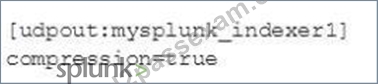
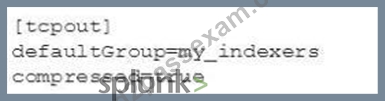
Which of the following enables compression for universal forwarders in outputs. conf ?
- A.

- B.
- C.
- D.

Answer: C
Explanation:
https://docs.splunk.com/Documentation/Splunk/latest/Admin/Outputsconf
# Compression
#
# This example sends compressed events to the remote indexer.
# NOTE: Compression can be enabled TCP or SSL outputs only.
# The receiver input port should also have compression enabled.
[tcpout]
server = splunkServer.example.com:4433
compressed = true
NEW QUESTION # 34
Which feature of Splunk's role configuration can be used to aggregate multiple roles intended for groups of users?
- A. Grantable roles
- B. Role inheritance
- C. Linked roles
- D. Role federation
Answer: B
Explanation:
You can have a role inherit certain properties from one or more existing rolehttps://docs.splunk.com
/Documentation/Splunk/8.0.5/Security/Aboutusersandroles
Reference: https://docs.splunk.com/Documentation/Splunk/8.0.5/Security/Aboutusersandroles
NEW QUESTION # 35
Which of the methods listed below supports muti-factor authentication?
- A. Lightweight Directory Access Protocol (LDAP)
- B. OpenlD
- C. Single Sign-on (SSO)
- D. Security Assertion Markup Language (SAML)
Answer: D
Explanation:
SAML is an open standard for exchanging authentication and authorization data between parties, especially between an identity provider and a service provider1. SAML supports multi-factor authentication by allowing the identity provider to require the user to present two or more factors of evidence to prove their identity2. For example, the user may need to enter a password and a one-time code sent to their phone, or scan their fingerprint and face.
NEW QUESTION # 36
......
Validate your Skills with Updated SPLK-1003 Exam Questions & Answers and Test Engine: https://examsforall.lead2passexam.com/Splunk/valid-SPLK-1003-exam-dumps.html