

H12-821_V1.0 Questions Prepare with Learning Information! 2026 Regularly updated
Get H12-821_V1.0 Products Practice Material for H12-821_V1.0 Exam Question Preparation
NEW QUESTION # 154
In the USG series firewall, what is the security priority of the Untrust zone?
- A. 0
- B. 1
- C. 2
- D. 3
- E. 4
Answer: A
NEW QUESTION # 155
Which of the following OSPF areas can only reach other areas through the default route?
- A. NSSA
- B. Backbone area
- C. Non-backbone area
- D. totally stub area
Answer: D
NEW QUESTION # 156
Which of the following options are available for the network type supported by the OSPF protocol? (Multiple choice)
- A. Point-to-Multipoint
- B. Non-Broadcast Multi-Access
- C. Broadcast
- D. Point-to-Point
Answer: A,B,C,D
NEW QUESTION # 157
As shown in the figure, R1 and R2 have configured the local sending time interval, the local receiving time interval and the local BFD detection multiple.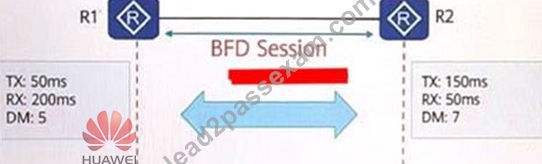
Which of the following descriptions of the time parameters after RI negotiation are correct? (Multiple choice)
- A. The sending time after R1 negotiation is 50 milliseconds
- B. The reception time after R1 negotiation is 150 milliseconds
- C. The reception time after R1 negotiation is 200 milliseconds
- D. The sending time after R1 negotiation is 150 milliseconds
Answer: A,C
NEW QUESTION # 158
Which of the following descriptions about AC roaming groups is wrong? (Multiple choice)
- A. The Master Controller must be the AC in the roaming group
- B. The ACs in the roaming group use DTLS extended tunnels to encapsulate and transmit roaming- related information
- C. STAs can roam only between ACs in the same roaming group
- D. The AC in the roaming group needs to deploy a Master Controller
Answer: A,B
NEW QUESTION # 159
Which of the following statements regarding IGMPv1 and IGMPv2 are true?
- A. 1GMPv2 supports only general query.
- B. 1GMPv2 defines the Leave message type.
- C. IGMPv1 supports general query.
- D. IGMPv1 does not define the IGMP Leave message type.
Answer: C
NEW QUESTION # 160
iMaster NCE-Campus can be used as an authentication server on a WLAN to authenticate STAs.
- A. FALSE
- B. TRUE
Answer: B
Explanation:
Comprehensive and Detailed Step-by-Step Explanation:
iMaster NCE-Campus Overview:
iMaster NCE-Campus is Huawei's network management platform for managing and controlling campus networks.
It supports user authentication, including STA (Station) authentication, in WLAN environments.
Authentication Modes Supported:
iMaster NCE-Campus integrates with AAA (RADIUS) servers to perform authentication for wireless clients.
Correct Statement:
The platform can function as an authentication server for WLAN STAs.
References:
HCIA-Datacom Study Guide, Chapter: WLAN Management with iMaster NCE-Campus Huawei iMaster NCE-Campus Product Overview
NEW QUESTION # 161
In BGP, the Origin attribute is used to define the source of path information and mark how a route becomes a BGP route.
Which of the following is the correct ranking of the priority of the Origin attribute?
- A. EGP>IGP>Incomplete
- B. IGP>Incomplete>EGP
- C. IGP>EGP>Incomplete
- D. Incomplete>IGP>EGP
Answer: C
NEW QUESTION # 162
Which of the following descriptions is wrong about the address function of NDP?
- A. When sending a Neighbor Solicitation message, the destination address is set as the multicast address of the requested node of the neighbor
- B. The address realizes the function from IPv6 address to link layer address
- C. When sending a Neighbor Solicitation message, the source address is set to be the link-local address of the local interface
- D. Two types of ICMPv6 packets, neighbor solicitation and neighbor advertisement, are used in the addressing process.
Answer: C
NEW QUESTION # 163
Regarding the OSPF multi-process description, the error is:
- A. An interface of a router can only belong to one OSPF process
- B. Different OSPF routers establish neighbors, and the process numbers must be the same
- C. The routing interaction between different OSPF processes is equivalent to the routing interaction between different routing protocols
- D. Multiple different OSPF processes can run on the same router, and they do not affect each other and are independent of each other
Answer: B
NEW QUESTION # 164
Which of the following statements is false about the default processing of the next hop address when a BGP device advertises a route?
- A. When advertising a route to an EBGP peer, a BGP device sets the next hop address to the IP address of its interface connected to the peer.
- B. A BGP device does not change the next hop address of a route if the route is received from an IBGP peer and is to be sent to another IBGP peer.
- C. When advertising a locally originated route to an IBGP peer, a BGP device sets the next hop address to the IP address of its interface connected to the peer.
- D. When advertising a non-labeled route received from an EBGP peer to an IBGP peer, a BGP device changes the next hop address to the IP address of its interface connected to the IBGP peer.
Answer: D
Explanation:
Comprehensive and Detailed Step-by-Step Explanation:
* Default Next Hop Behavior in BGP:
* Locally Originated Routes (A): The next hop is set to the advertising router's interface IP address.
* Routes Received from EBGP (B): The next hop is not changed when these routes are advertised to IBGP peers. (This makes Option B false.)
* Routes Advertised to EBGP (C): The next hop is set to the interface IP address of the advertising router.
* Routes Advertised Between IBGP Peers (D): The next hop is not modified by default.
* Incorrect Statement:
* Option B is incorrect because the next hop of a non-labeled route received from an EBGP peer is not changed when it is advertised to IBGP peers.
References:
* HCIA-Datacom Study Guide, Chapter: BGP Next Hop Behavior
Huawei BGP Routing Principles
NEW QUESTION # 165
Which of the following statement regarding the display ospf peer command output is true?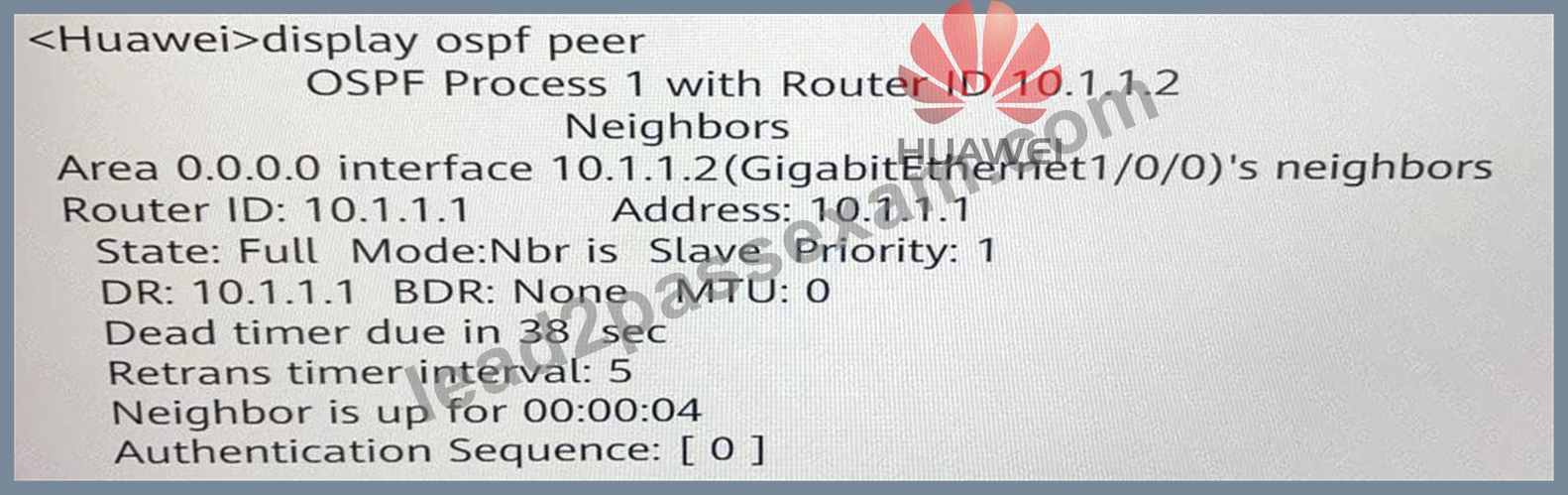
- A. Address: 10.1,1.1 Indicates that the local interface address is 10.1.1.1.
- B. Router ID indicates that the local router ID Is 10.1.1.1.
- C. The DR address is 10.1.1.1
- D. Through negotiation during DD packet exchange, the local end becomes the slave.
Answer: D
Explanation:
The command output indicates that the OSPF neighbor state is Full and that the neighbor relationship has been established. The statement confirms that the negotiation process during the exchange of DD (Database Description) packets has determined the role of the router, with the local device becoming the slave in the Master-Slave relationship, which is critical for LSA synchronization. The other options do not align with the output or OSPF principles
NEW QUESTION # 166
Which of the following statements is true about BGP?
- A. IGP routes can be converted into BGP routes only through the network command.
- B. If the export routing policy applied to a BGP peer changes, manual intervention is required so that the device resends Update messages to the peer.
- C. Open messages carry only the BGP header.
- D. A router cannot be configured with multiple BGP processes.
Answer: B
Explanation:
Export Routing Policy Changes
When an export routing policy is modified, BGP does not automatically resend affected routes. Manual intervention, such as a clear ip bgp command, is required to resend Update messages reflecting the new policy.
NEW QUESTION # 167
ASPF (Application Specific Packet Filter) is a packet filter based on the application layer. It will check the application layer protocol information and monitor the application layer protocol status of the connection, and implement a special security mechanism through the Server Map table. Then which of the statement about ASPF and Server map table is wrong?
- A. ASPF dynamically creates and deletes filtering rules
- B. The Server-map entry in the quintuple implements a function like the session table
- C. ASPF dynamically allows multi-channel protocol data to pass through the Servermap table
- D. ASPF monitors the packets in the communication process
Answer: B
NEW QUESTION # 168
IGMP SSM Mapping statically binds the multicast source to the multicast group, so that group members of IGMPv1 and IGMPv2 can also access the SSM multicast network. Which of the following descriptions about IGMP SSM Mapping is wrong?
- A. Statically configure the mapping rules of the SSM address on the IGMP querier, and map the group joining information in the IGMPv1 or IGMPv2 member report to the group leaving information
- B. If the IGMP SSM Mapping function is not enabled, neither IGMPv1 nor IGMPv2 support the deployment of multicast in SSM mode
- C. IGMP SSM Mapping does not process IGMPv3 report messages. In order to ensure that hosts running any version of IGMP on the same network segment can get SSM services, it is necessary to run IGMPv3 on the multicast router interface connected to the network segment where the member hosts are located.
- D. The address of the multicast group of SSM is 232.0.0.0~232.255.255.255
Answer: A
NEW QUESTION # 169
In which of the following scenarios can a neighbor relationshipnotbe established between two directly connected Huawei routers after IS-IS is configured?
- A. The two routers are Level-2 routers and have different area addresses.
- B. The two routers are Level-2 routers with the same area address, and the interfaces connecting them are on the same network segment.
- C. The two routers are Level-1 routers and have different area addresses.
- D. One router is a Level-1 router, and the other router is a Level-2 router.
Answer: C
Explanation:
In IS-IS:
Level-1 routerscan only form neighbor relationships with other Level-1 routersin the same area.
Level-2 routerscan form neighbor relationships with other Level-2 routersregardless of area ID.
Level-1-2 routerscan form relationships at both levels depending on the peer's configuration.
So, iftwo Level-1 routershavedifferent area addresses, theycannotestablish a neighbor relationship.
Reference from Huawei HCIP-Datacom-Core Technology Study Guide:
"Level-1 routers must have the same area address to establish neighbor relationships. Level-2 routers can peer across different areas." (Chapter: IS-IS Protocol Principles - Section: Neighbor Establishment)
NEW QUESTION # 170
......
Most Reliable Huawei H12-821_V1.0 Training Materials: https://examsforall.lead2passexam.com/Huawei/valid-H12-821_V1.0-exam-dumps.html